The First Three Months After Diagnosis
Have you been diagnosed with asthma and started treatment? In this article we explain what to expect in the first months, what to write down at home, how to prepare for your follow-up and when to seek help without waiting for an appointment.
In brief
Did you leave the clinic with a diagnosis and treatment instructions, but without a follow-up appointment?
According to GINA, the global asthma guidelines, booking a follow-up appointment is part of starting treatment, along with recording the diagnosis, measuring lung function and checking how you use your inhaler.
The effect of preventer treatment builds up gradually. According to the guidelines, a first follow-up is recommended one to three months after starting treatment. In practice, the appointment with the pulmonologist may only be available in another 3 to 6 months. You don't need to wait for it to get follow-up care: see your family doctor and ask what to do in the meantime. After an attack or urgent treatment, an earlier check-up is needed, according to the instructions you were given. During this period, it is a good idea to write down what has changed in your breathing and in your inhaler use.
If you don't have an appointment yet, ask to book one. If you haven't received clear instructions on what to take and when to seek help, ask for a personal written plan right away. This article will help you prepare for your follow-up and understand what is important to ask about, but it does not replace a visit with your care team.
“Booking a follow-up appointment is part of starting asthma treatment.”
When You Start to Feel the Treatment Working
You may not feel the full effect of your preventer inhaler on the first day. According to the UK's National Health Service (NHS), with an inhaler containing the steroid beclometasone, people usually notice less wheezing or less shortness of breath after 3 to 7 days. The full effect may only come after a few weeks. On the same page, the NHS advises contacting a doctor or nurse soon if shortness of breath or wheezing has not improved after seven days, or if it gets worse. This guidance refers to beclometasone; it is not a general waiting time for every inhaler, and certainly not during an attack.
Preventer treatment works on the inflammation in the airways, the passages that carry air through the lungs. If you have been prescribed daily treatment, keep taking it as instructed even when you feel better. The NHS stresses this for beclometasone, and Maccabi (an Israeli health fund) notes that full protection comes with continuous use.
If your symptoms continue without improvement, don't assume you just need to wait for the full effect. Contact your care team to check how you are responding to treatment and how you use your inhaler. Steroid-only inhalers include, for example, Flixotide and Budicort. Examples of combination inhalers are Symbicort, DuoResp, Foster, Relvar and Seretide. These are examples of brand names, not a complete list or information on available stock; the specific product, strength and type of device determine the instructions.
When to Check Whether the Treatment Is Working
The follow-up visit is meant to check how you are doing on the treatment and whether it needs to change. Even when your pulmonologist appointment is far off, you can see your family doctor to assess your response to treatment and get instructions until the visit.
GINA recommends a routine check-up one to three months after starting treatment. The joint 2024 UK guideline from NICE, BTS and SIGN recommends checking the response within 8 to 12 weeks. These are two recommendations for follow-up after starting treatment, not two separate appointments you need to book.
After an asthma flare-up (exacerbation), an earlier check-up should be booked. According to GINA, adults and older children are usually advised to have a check-up within a week; for children aged 5 and under, a check-up within one to three days after the flare-up is recommended where possible. Your personal check-up date depends on your condition and your discharge instructions. These are follow-up times after treatment for a flare-up, not a period to wait out if there is no improvement or if things get worse.
The check-up covers several topics:
- Symptoms, flare-ups and side effects. An asthma flare-up is also called an exacerbation. According to GINA, these three topics are checked with every change in treatment.
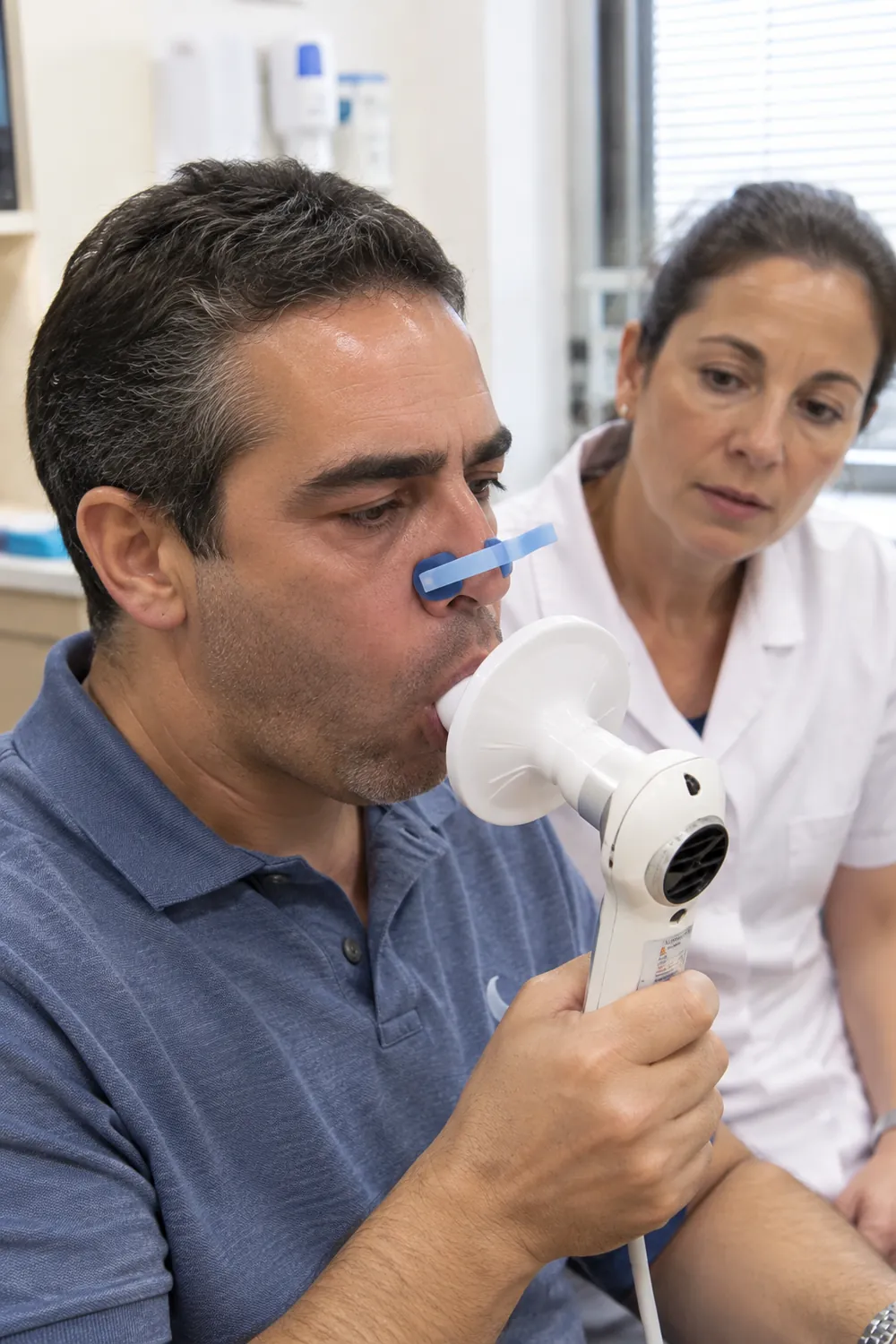
- Lung function. According to GINA, the measurement is repeated 3 to 6 months after starting inhaled steroid treatment. It aims to record your best lung function, called your personal best, so later measurements can be compared with it.
- How the treatment fits into your life. GINA advises the doctor to ask whether you are satisfied with your treatment. This is a chance to say what works for you and what makes things hard.
- Whether treatment can be reduced. In adults and teenagers, reducing treatment can be considered when asthma has been well controlled and lung function stable for at least three months. This refers to how long the asthma has been controlled, not the time since diagnosis. Before reducing treatment, the doctor also checks the risk of a flare-up, updates your personal written plan and schedules follow-up. When talking about control, doctors look at daytime symptoms, waking at night, need for a reliever inhaler and interference with normal activities.
- What is checked if asthma is not controlled. Before increasing the dose, GINA advises checking how the treatment is actually being taken, how you use your inhaler, exposure to triggers in your surroundings and other health conditions. It is also important to confirm that the symptoms really are caused by asthma. The decision to change treatment is the doctor's.
What to Write Down From Day One
Write down what has happened since you started treatment, even if only a few weeks have passed. Details that seem small now may be hard to remember at your next visit. Also record any flare-ups, oral steroid treatment (steroid tablets or liquid) and visits to an urgent care center or emergency room, if there were any.
- When you started treatment. You can save the date in the notes on your phone.
- If you were prescribed regular treatment: how many days a week you actually took it. GINA suggests finding out on how many days a week the medicine prescribed for regular use was taken over the past four weeks: not at all, one day, two days, or three days or more. If you started less than four weeks ago, record the time that has passed. This question is not meant to count days when you didn't need a treatment prescribed for as-needed use only. According to the guidelines, about half of people on long-term treatment don't take it as agreed, at least some of the time. This information helps the doctor understand your response to treatment and plan next steps.
- Use of your reliever inhaler and the date you bought it. This is the inhaler you use to relieve symptoms when they appear. If it has a dose counter, also write down what it shows. The counter is a small window that shows how many doses are left in the inhaler. You can check your purchase history in your health fund's (HMO's) app. In your notes, keep regular puffs, puffs to relieve symptoms and puffs before exercise separate.
- Your breathing during the day and night. Write down when you had symptoms, whether they woke you at night, when you used your reliever inhaler and whether asthma interfered with your activities. These are the four topics GINA uses to assess asthma control. The article “Is My Asthma Under Control?” explains how these questions are used; here the aim is to record what happens.
“Keeping a record of your symptoms and inhaler use helps you arrive at your follow-up with a clearer picture.”
How to Make Sure You Are Using Your Inhaler Correctly
You can have your inhaler technique checked even before your follow-up appointment. GINA advises the care team to watch you use your inhaler, rather than just asking whether you know how. According to Clalit (an Israeli health fund), you can get guidance from your doctor, nurse or pharmacist. If you are not sure how to use your inhaler, you can also use online instructional videos made for your specific inhaler. Bring your inhaler to your doctor's appointment to show how you use it.
Shaking the Inhaler and Using a Spacer
- Check whether your inhaler needs shaking. A spray (aerosol) inhaler releases the medicine when pressed; with a powder inhaler, you breathe in the medicine as a fine powder. GINA notes that in spray inhalers where the medicine is a suspension, meaning particles that settle in the liquid, you need to shake right before each press to mix them again. Examples are salbutamol spray inhalers, including Salbuterim and CFC-free Ventolin, whose discontinuation we discuss below. By contrast, a spray inhaler such as Trimbow does not need shaking. So the shaking instructions should match your specific inhaler, not be based on how it looks. Dry powder inhalers are not shaken. In Israel, Symbicort and DuoResp are sold as powder inhalers in Turbohaler and Spiromax devices.
- Learn how to breathe through a spacer. A spacer, also called a holding chamber, is a container that attaches to a suitable spray inhaler and that you breathe in through; it is not meant for powder inhalers. Release one press at a time, not several presses together. Anyone who can take a slow, deep breath and hold it can use this technique as instructed. For children aged 5 and under, when giving a bronchodilator (a medicine that opens the airways) by spray inhaler with a spacer, GINA recommends normal breaths, usually 5 to 6 breaths after each press, with a suitable mouthpiece or mask. Normal breaths are not only for attacks or for times when a deep breath isn't possible. Practice using it in a way that suits the device and the person's age.
- Ask for another demonstration if needed. GINA advises the care team to demonstrate the correction and then watch you try again. Sometimes this is repeated two or three times in the same visit. The check itself takes 2 to 3 minutes, and mistakes tend to come back within 4 to 6 weeks. That is why it is important to have your technique checked again.
This guidance can affect treatment results. In a 2013 randomized trial in pharmacies in Spain, structured support from pharmacists, including work on inhaler technique and sticking with treatment, improved asthma control after six months compared with usual care. 336 adults completed the study. The statistical measure found, an odds ratio of 3.06, does not mean that a person's individual chance of achieving control tripled. Nor should the study be taken to mean that a single demonstration alone would achieve the same result.
“To check your inhaler technique, it is important for the care team to see you use it.”
What You Can Do When Your Appointment Is Two Months Away
Ways to Get Advice Before Your Follow-Up Appointment
- Your family doctor. Contact them to check how you are responding to treatment and to ask what you can do until your pulmonologist appointment. If you need to be seen before the appointment, you can also go to an urgent care center, depending on your condition and the guidance on when to seek help below.
- Your health fund's nurse line. Maccabi runs a 24/7 phone medical advice line at *3555. This is an advice line, not an emergency line. The nurses do not issue prescriptions. The nurse may refer you to a doctor for advice, at their discretion and during doctors' working hours. For a routine prescription renewal, contact your treating doctor. Other health funds have similar lines; check the hours on your health fund's website.
- Remote family doctor. Clalit runs an online family doctor service for ages 18 and over, every day from 08:00 to 23:00, including weekends and holidays. The service is free, by video or phone, for up to 12 consultations per calendar year. To renew a regular inhaler prescription, contact your treating doctor. Check the current terms of service on your health fund's website; online consultation is not a substitute for emergency care.
- Asking for an earlier appointment. Explain that this is a follow-up after starting treatment and ask for an earlier date. If you don't get a response, later in this article we explain where you can turn about waiting times.
When to Seek Help Before Your Next Appointment
Guidance on Seeking Help Should Match Your Reliever Inhaler
- An inhaler containing a steroid and formoterol. Ask your doctor for instructions that state the exact inhaler, the amount of medicine in each puff, the device, the age the instructions apply to, and how you were prescribed to use it. Distinguish between regular puffs and reliever puffs, and find out how to count all your puffs per day, that is, over 24 hours. Do not apply one fixed number to all inhalers based only on names such as Symbicort, DuoResp or Foster.
- An inhaler containing only a bronchodilator, such as salbutamol or Bricalin. A bronchodilator is a medicine that opens the airways. Ask for instructions that state how many puffs to take, when you can repeat them, and when needing extra puffs means you should contact your doctor and have your preventer treatment reviewed. For adults and adolescents, this kind of inhaler is not a stand-alone asthma treatment: on the same day, make sure to also take your steroid-containing inhaler, according to your treatment plan and the instructions you received.
- An inhaler combining a steroid and salbutamol. Here too, you need instructions for the specific product. It is important to distinguish between a dose and a puff, and to confirm how many puffs are in each dose and when to seek help.
- If symptoms continue without improvement between attacks, or you need relief again and again, contact your care team before your follow-up appointment. During an attack when your reliever inhaler isn't helping, or if your condition is getting worse quickly, call an ambulance at 101. Don't wait to reach the maximum number of puffs or for your follow-up date to get emergency help.
- For parents of children aged 5 and under. Children this age have separate instructions for inhalers containing a short-acting bronchodilator. According to GINA's detailed chapter, if relief after the inhaler lasts less than four hours or keeps getting shorter, seek a medical assessment right away. If the child needs the inhaler more than three times within 12 hours, they need a medical check the same day, even if there was temporary relief. Don't wait for these thresholds if the child is struggling to breathe or if the inhaler doesn't help during an attack: call an ambulance at 101. Ask in advance for personal written instructions that set out the right use for your child and when to seek help.
- With emergency signs, don't wait for a set number of puffs. If shortness of breath makes it hard to say a full sentence, drink or lie down, or if there are bluish lips, confusion or drowsiness, call an ambulance at 101. Any one of these signs is enough to seek help; they don't all need to appear. The article “Asthma Attack — What to Do” explains more about recognizing an attack and seeking help.
You may come across Israeli websites recommending starting treatment with a bronchodilator alone. For adults and adolescents, GINA recommends that asthma treatment also include an inhaled steroid. It is important to distinguish between the treatment recommendation and the question of which products are available in Israel.
The discontinuation notice for the Ventolin CFC-free inhaler, containing salbutamol 100 micrograms per dose in a pack of 200 actuations, is dated 15 October 2025. The permanent discontinuation start date listed in it is 15 April 2026. This is not the same notice as the one about the temporary discontinuation of Ventolin Diskus, which is a different product. Do not conclude from such notices that all salbutamol products have been discontinued or that every pharmacy has an alternative in stock.
Do not rely on a bronchodilator alone as the only asthma treatment for adults and adolescents. It may be used as a reliever inhaler alongside suitable treatment that contains an inhaled steroid. Salbutamol is also sold as Salbutrim, but check whether it is actually available. If your inhaler isn't available, contact your doctor or pharmacist to arrange an alternative and get guidance on using the device; don't stop or switch treatment on your own. At your appointment, also ask when you should seek help based on the inhaler you were given.
Challenges to Watch For in the First Months
- Stopping treatment when you feel well. According to GINA, adults and adolescents with asthma should not completely stop inhaled steroid treatment, because stopping fully is linked to a significantly higher risk of a flare-up. In suitable cases, when the diagnosis needs to be confirmed, the doctor may plan a temporary reduction in treatment with a review after 2 to 4 weeks. If, after stepping down to a low dose, there is no flare-up and tests still show no evidence confirming asthma, the doctor may consider a supervised stop. In that case, a repeat check is needed within 2 to 3 weeks, along with follow-up for at least 12 months. This is an assessment that the doctor plans and oversees, with personal instructions; don't do it on your own.
- Relying on a bronchodilator alone. In studies of adolescents and adults with mild asthma, low-dose budesonide and formoterol taken as needed reduced flare-ups and urgent visits compared with a short-acting bronchodilator alone taken as needed. Summarizing the studies, GINA reports a 55% reduction in flare-ups requiring oral steroids and a 65% reduction in hospital admission, emergency room visits or other urgent medical care. These figures are based on odds ratios, a research measure that does not necessarily describe the same reduction in an individual person's risk. In this comparison, follow-up in the studies lasted a year, not just the first three months of treatment. Even people whose symptoms are rare can have a severe flare-up.
- Using an inhaler without having your technique checked. According to GINA, as many as 70% to 80% of people with asthma may not use their inhaler correctly, and most are not aware of it. The guidelines note that many healthcare staff also cannot correctly demonstrate the inhalers they prescribe. So ask for a demonstration and practice together, rather than settling for a verbal explanation.
- Changing the dose on your own. If treatment isn't helping, a higher dose is not always the answer. First, check how the treatment is actually being taken and how the inhaler is used. In some situations, the doctor may even recommend a temporary reduction to clarify the diagnosis. Any such change is made under the doctor's guidance. Following personal instructions given in advance is not changing the dose on your own.
What to Bring to Your Next Appointment
- Your inhalers themselves, so the team can see how you use them and check your technique.
- A note of the dose counter reading, if there is one, and of the purchase dates. This makes it easier to describe your use without relying on memory alone.
- A record of your reliever inhaler use: when you used it and how many puffs you took. Keep use for symptom relief separate from use before exercise. If you were also prescribed a regular treatment, keep taking it every day as instructed.
- Your doctor's personal written instructions, also called an asthma action plan, to review and update. If you haven't received them yet, ask for them now. According to GINA, every person with asthma should receive such instructions, printed, digital or in pictures, and not just a verbal explanation. They should explain what to do when your condition gets worse, and when and how to seek help.
- An organized page with your information and questions. It will help you make the most of the appointment and raise the things that matter to you.
“Even when you feel better, don't change your treatment on your own.”
In the first months, you also learn how much treatment is needed to keep your asthma under control. So its severity may not have been determined yet.
According to GINA, severity is determined by the level of treatment needed to achieve control, so it can only be assessed after a few months of treatment. Even then, inhaler technique, how the treatment is actually taken and other health conditions are checked first. Still, from the very start, your doctor assesses your risk of a flare-up and explains when you need to seek medical care, even if the severity has not been determined yet.
Frequently asked questions
Questions About the First Months of Treatment
I've been taking the inhaler for two weeks and don't feel any difference. Should I stop?
Don't stop treatment on your own, but don't wait several more weeks without checking either. If two weeks have passed with no improvement, contact your care team so they can check how you are responding to treatment and how you are using the inhaler. For beclometasone, the NHS notes that initial improvement is usually felt after 3 to 7 days, and that the full effect may take several weeks. However, it advises contacting a doctor or nurse soon if shortness of breath or wheezing has not improved after seven days, or if it is getting worse. During an attack where the reliever inhaler doesn't help, if things get worse quickly, or if you notice the emergency signs listed above, call an ambulance on 101.
I don't have an appointment for the next two months. Is that reasonable?
If you are gradually improving, a routine follow-up in about two months is within the range described in the guidelines. After an attack or urgent treatment, an earlier check-up is needed, according to the instructions you were given. In the meantime, contact your family doctor for follow-up and guidance until your appointment with the pulmonologist. You can also use the nurse hotline, get guidance at the pharmacy, and keep a record of your symptoms and inhaler use. If there is no improvement, if you are still waking up several nights a week because of your asthma, or if you repeatedly need symptom relief or your need for the reliever inhaler is increasing, don't wait for your appointment. Contact your care team for an assessment based on your inhaler and treatment plan. Regular maintenance puffs should not be counted as reliever use. During an attack that the inhaler does not relieve, if things get worse quickly, or if you notice emergency signs, call an ambulance on 101.
Should I fill out the ACT questionnaire before the appointment?
The standard ACT (Asthma Control Test) has five questions and is intended for ages 12 and up. It assesses how well your symptoms are controlled and can help you prepare for your appointment. Scores range from 5 to 25: according to GINA, 20 to 25 indicates well-controlled symptoms, 16 to 19 indicates symptoms that are not well controlled, and 5 to 15 indicates very poorly controlled symptoms. Children aged 4 to 11 have a different questionnaire, and these ranges do not apply to it. According to GINA, the standard questionnaire has not been validated for people whose reliever inhaler combines a steroid with formoterol, nor for a combination of a steroid and a short-acting bronchodilator such as salbutamol. Also bring a record of your inhaler use. The score does not replace an assessment of your risk of future attacks or an examination during a flare-up.
What can I do if my health fund won't move my appointment earlier?
Contact your family doctor and ask what can be done until your appointment with the pulmonologist. If you need a medical examination before the appointment, you can also go to an urgent care center, depending on your condition and the guidance on getting help in this article. The nurse hotline and online doctor services can help with advice, but they are not a substitute for emergency care. For questions about waiting times, you can contact the Ministry of Health's "Kol HaBriut" (Voice of Health) hotline at *5400. The Ministry also has a Public Complaints Commissioner for the National Health Insurance Law, which, among other things, looks into complaints about waiting times. Filing a complaint does not replace medical care you need right now.
Medical review and consultation: Dr. Merav Ben Avraham, Specialist in family medicine and pulmonology